Table of Content
What Is Customer Experience Management?
Customer experience management (CXM or CEM) refers to how organizations track or oversee and organize customer interactions throughout the customer life cycle. Every employee in an organization and every decision made affects customer experience (CX) in one way or another.
In short, decision-making in an organization affects the organization’s relationship with customers. As a result, organizations that do a better job at customer experience management often perform better in the market.
Why Is CXM Important?
Customer experience (CX) contributes to a customer’s brand perception. As a result, it has a direct impact on sales. Coming up with a CXM strategy can help an organization improve CX. Here’s why organizations need CXM:
- Customer Retention Is Cheaper Than Acquisition
Studies show a 5 percent increase in customer retention in an organization results in a 25 percent increase in profits. After all, a retained customer costs way less than acquiring a new one. Also, satisfied customers tend to spend more. - Feedback from Customers Helps Organizations Improve CX
By analyzing CX across all channels, organizations can collect CX feedback from customers. As a result, leaders can create a blueprint for improving CX and customer retention. - Happy Employees Often Lead to Happy Customers
There’s a direct connection between employee experience and CX. Companies use CXM to measure employee experience to improve CX and customer retention. - Contented Customers Refer Brand to Peers
A happy customer’s endorsement is often more valuable than advertising. - Measuring Customer Sentiment Uncovers Competitor Information
Customers usually compare brands when making a purchase design or giving feedback. Monitoring customer sentiment can help an organization position itself favorably against the competition.
How Can You Improve Customer Experience?
What is the best way to improve customer experience? Positive customer experience is critical for business success because satisfied customers turn into loyal ones who help boost revenue. It may seem like extra effort from the outset, but it’s worthwhile in the long run. In fact, enterprises that lead in customer experience outperform those that lag by almost 80 percent.
Here are six ways companies can improve customer service in 2021.
-
- Build an Omnichannel Customer Experience Strategy
An omnichannel strategy helps organizations get insights into customer behavior and interactions across their life cycles.
-
- Deliver Superior Customer Service
Organizations must evaluate every interaction with customers and try to improve it. Customer-focused organizations are 60 percent more profitable.
-
- Train Customer Facing Agents
The first people to interact with customers leave a lasting impression about the organization. Companies must put their best foot forward to train customer service agents.
-
- Create Self-Service Options
Having a dedicated customer service team is good. But this is a reactive approach to customer service. Putting in place measures that allow for more proactive action by customers helps improve customer experience.
-
- Tap into the Power of AI (Artificial Intelligence)
The role of AI in improving customer experience is growing by the day. Organizations are deploying chatbots to improve self-service and getting real-time insights across contact channels. AI is also helping to optimize agent availability and wait times.
-
- Use Customer Analytics
Today, organizations are using a wide variety of channels to monitor CX performance. Customer analytics tools allow organizations to get comprehensive insights that allow them to maximize opportunities from customer interactions.
Conclusion
SuccessKPI allows organizations to improve customer experience with enterprise-grade contact center analytics powered by AI and ML.
What Is Contact Center Analytics?
Call center analytics refers to the processes and tools that organizations use to gain business performance insights. Management can track and improve various service metrics, including call times, employee performance, efficiency, and customer satisfaction.
By processing unstructured data from different sources into useful reports, organizations that use call center analytics can formulate customer-centric strategies for their contact centers.
Types of Contact Center Analytics
- Contact Center Speech Analytics
Speech analytics can help call center agents manage the customer experience by learning from positive and negative customer interactions and how to mitigate customer issues through coaching and training learned from speech analytics. - Contact Center Text Analytics
Text analytics provides an analysis of the transcription of text interactions between a customer and an agent. Text analytics works for e-mail, Twitter, Facebook, and other text-based media. Text-based interactions can be improved by identifying weaknesses in automated responses and improving the AI experience before an agent transfer is required. - Contact Center Desktop Analytics
Desktop analytics involves monitoring desktop activities of call center agents and system performance. By analyzing desktop activities, it is possible to achieve significant process improvements for the call center. Organizations can use desktop analysis alongside call monitoring to improve call center security, capture inefficiencies, and identify phone agent coaching opportunities. - Contact Center Cross-Channel Analytics
Cross-channel analytics seeks to understand which paths or channels combine to drive customer conversion. This includes understanding what paths are popular within and across channels and finally provide a detailed analysis of specific visitor paths. By finding this path, marketers can concentrate advertisement and marketing efforts along that path or create other avenues just like it. Also, analysts can understand the impact of each channel and how they work together. - Contact Center Self-Service Analytics
Self-service analytics evaluates customer experience in the organization’s self-service channels. Users can drill and discover improvement areas for a whole range of customer self-service solutions and gain a full picture of the underlying efficacy, automation rates, and sentiment of these customer self-service tools. - Proactive Analytics
Through proactive analysis, management can evaluate and identify ways to communicate effectively with customers. Proactive analytics allow businesses to make changes that improve by seeing developments as they occur in real-time. This can mean taking advantage of a sudden surge in a specific products’ popularity or reducing production when sales decline as it happens instead of after. This method should be the standard approach to information gathering and subsequent decision-making. With proactive analytics, you can harness the power of your data to project trends in your industry and adjust to your audience’s key pain points.
What are call center analytics? SuccessKPI.com provides organizations with call center analytics that give management full visibility across all channels.
What Are Metrics in a Call Center?
Metrics in a call center refer to data for different call center aspects, such as call time, call volume, call abandonment, average handle time and other agent and queue based metrics. These metrics are the flakes, nuggets, and specks of gold that reveal the truth about call center operations.
Metrics for Connecting with an Agent
- Average Call Abandonment Rate – This refers to the proportion of customers who initiate a support call and hang up before an agent connects with them.
- Percentage of Calls Blocked – This is the proportion of customers who make a support call but receive a busy tone that stops them from connecting with an agent.
- Average Speed of Answer (ASA) – This is the average time it takes for agents to answer customer calls.
- Average Time in Queue – This is the length of time customers spend waiting from when they make a support call until they’ve spoken to an agent.
These metrics are critical for CX since shorter wait times generally make customers happy.
Metrics for Issue Resolution
- Average Handle Time (AHT) – This refers to the time it takes from the moment an agent connects with a customer until the interaction ends.
- Average Talk Time (ATT) – This refers to the time the agent is actually talking to the customer.
- Average After-Call Work Time – This refers to the time spent by an agent to follow up on a customer’s case after the interaction has ended. For example, follow-up activities might include submitting notes to the manager or filing a bug fix with the IT team.
- Repeat Calls – This metric reflects contacts from the same phone number or email that recur within a specified time period.
- Time to Resolve – This metric is similar to Average After-Call Work Time and AHT. Time to Resolve includes the time the customer initiates a support call until the center has fully resolved the issue.
- First Call Resolution (FCR) – This refers to the proportion of cases resolved by a single interaction between an agent and a customer.
- Channel Switch – Channel Switch is the ability to resolve an issue in the same channel through which a customer raised it.
- Self-Service Deflection – This is the proportion of customers who resolve their issues via an online knowledge base, forum, or any other self-service portal.
Out of these six metrics, FCR and AHT are the most commonly used in the call center; however, these metrics used in isolation only tell part of the story when you cannot see inside the customer conversations. More advanced metrics surrounding sentiment, sentiment by channel, topic, and theme detection powered by speech analytics and machine storing can take your analytics to the next level. Further, integrating data from other sources such as CRM and WorkForce Management (WFM) tools can further enrich your awareness and develop a total 360 degree view.
Conclusion
Organizations today can harness the power of call center metrics to gain insights into their call center operations. However, relying on these metrics alone can limit your insight. SuccessKPI provides call center leadership with a 360-degree view by blending hundreds of metrics from qualitative and quantitative historical and real-time data elements.
How to Improve Call Center Metrics?
Improving call center metrics is critical to improving CX. Here are some of the ways you can improve call center metrics in your organization.
1. How to Improve Customer Satisfaction
The goal of the contact center is to keep service costs low while maintaining higher caller satisfaction. Here are some ways organizations can improve customer satisfaction:
- Keep call center employees happy.
- Resolve customer calls the first time.
- Use call-backs and eliminate hold time.
2. Improving First-Call Resolution
There’s no shortcut for improving first-call resolution. Organizations have to focus on three key areas – product, process, and people. To improve this metric, call center leadership must ensure agents have good listening skills and can solve problems. They should sound confident, anticipate caller questions, and follow through on any commitments they make during the call.
3. Improving Employee Satisfaction
Call center leaders should take proactive measures to stop call center agents from becoming disengaged and ultimately leaving the job. While keeping employees happy may not be easy, it helps reduce agent churn and talent loss. Here’s how enterprises can improve employee satisfaction:
- Conduct employee satisfaction surveys.
- Put in place career development pathways.
- Deliver well-structured benefit plans.
- Recognize and reward good performance.
- Create an environment with a good work-life balance.
4. Improving Average Handle Time
Here’s how enterprises can improve average handle time in the call center:
- Providing agent coaching in multiple skillsets
- Optimizing IVR by using skills-based routing
- Learning how to anticipate questions from customers and provide the right information
- Automating tasks where possible
- Giving agents the right resources
Conclusion
Enterprises cannot improve what they don’t measure. SuccessKPI provides the tools modern-day call centers use to monitor and improve their key metrics.
What is Speech Analytics?
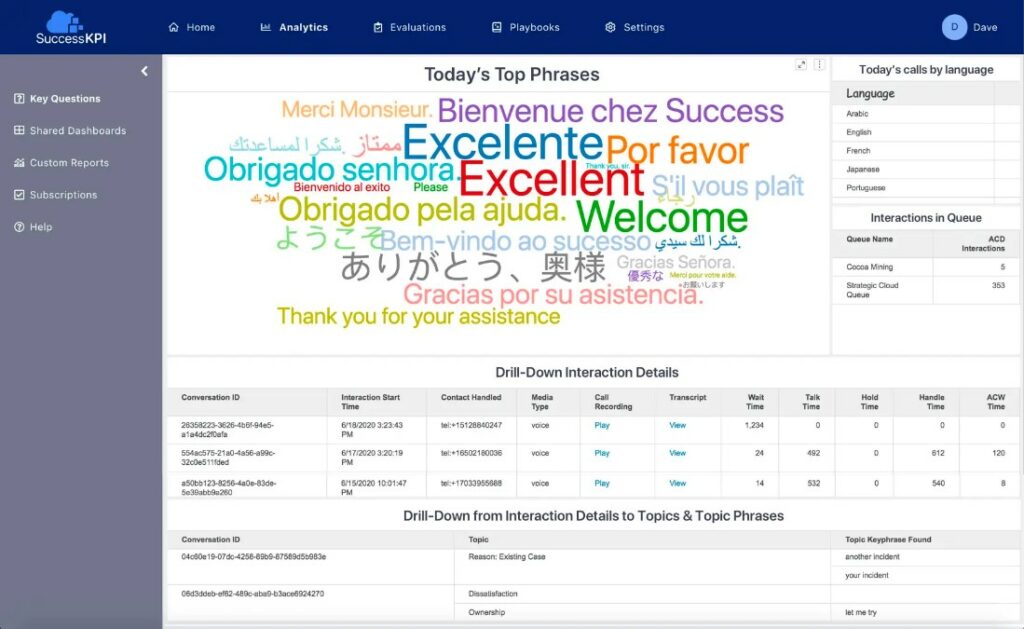
Speech analytics is the process of analyzing customer interactions, like voice recordings or live customer calls to contact centers to find useful information and provide quality assurance. Businesses use speech analytics during customer interactions to collect data. This data includes the reason for the call, the caller’s mood, and the products mentioned. When used effectively, speech analytics can accurately determine customers’ expectations, needs, and wants. Organizations utilize this data to identify customer issues, highlight areas that need improvement, and improve the customer experience.
What Is Speech Analytics Software?
Speech analytics software can detect themes, sentiments, reasons for a call, identify products, and customer satisfaction from call recordings and/or media streams in real-time. Speech analytics software helps businesses analyze live and recorded calls between customers and customer support teams. The software gives businesses better customer insight into how to improve their sales and customer engagement practices. Here are a few benefits of speech analytics software:
360-Degree Visibility into All Conversations: Speech analytics helps contact center management intelligently analyze historical and real-time calls to evaluate customer experiences and identify agent coaching opportunities.
Effective and Efficient Quality Management: Organizations can save demonstrable time and effort by prioritizing the right interactions for assessment. By highlighting key moments in each conversation, it becomes easier to identify areas where agents can improve.
Encourage Customer-Focused Decision-Making: Speech analytics makes it easier to collect impactful insights that empower sales and marketing teams. By leveraging these deeper insights, organizations can make informed decisions to provide the best customer experience during interactions with self-help applications or direct communications with an agent.
How Does Speech Analytics Work?
Speech analytics is a multistep process that involves the analysis of recorded calls to gather critical customer information. Speech analytics tools take unstructured audio data and convert it into a more structured format that organizations can search and analyze. This data helps organizations determine the reasons for customer calls and provide real-time and historical analytics to improve future interactions.
The Speech Analytics Process
Step 1: Gathering Audio Conversations
A speech analytics tool processes the unstructured data in source systems, such as call recorders or VoIP streams. The tool then matches the data with structured metadata, such as agent name, customer name, time, and call length.
Step 2: Speech Recognition
Now the audio goes through the speech recognition process. The speech analysis software turns the sound into text. As this happens, the tool also extracts the acoustic signals, such as silence and agitation in the voice.
If an organization uses multiple channels to communicate with clients, the tool deals with nuanced differences in various conversation formats. Consequently, enterprises can follow customers’ journeys and identify repeat contacts irrespective of the communication channels they used.
Step 3: Analysis
Next, the speech analytics tool examines the conversations for language patterns. The tool tags or categorizes contacts as containing certain characteristics or language. Some advanced speech analytics tools also support automatic scoring. Automatic scoring involves the identification of key metrics that act as performance indicators for various goals. For example, enterprises may need to keep track of customer service agent quality, emotion, first contact resolution, and customer satisfaction.
This step gives organizations accurate and objective feedback that management can use to personalize agents’ coaching and training.
Step 4: Results
Companies get actionable customer insights that management can share across the enterprise.
SuccessKPI Speech Analytics can help organizations bring speech to life with valuable insights and get a better understanding of customer experience. Speech Text Analytics
What Is Voice Analytics?
Voice analytics is the use of speech recognition tools to record and analyze conversations. Voice analytics tools translate speech to text and identify speaker emotion and intent.
Voice analytics first emerged in the early 2000s. This discipline has since grown in importance, with more and more enterprises investing in voice analytics technology to better improve customer experience and to understand what is happening in their contact center.
Importance of Voice Analytics
Voice analytics brings enormous benefits to the modern-day enterprise across dozens of industries from insurance and financial services to health care and technology. Voice analytics software helps generate insights about customer experience and to develop strategies to better serve customer needs.
Voice analytics tools help organizations process and analyze enormous volumes of customer conversation data. By using this data, companies can identify important information and trends that could easily be overlooked without a system that works at scale.
Benefits of Voice Analytics
Voice analytics can help with customer service and client call center management by identifying the following insights:
- Customer Satisfaction
With the help of a voice analytics tool, you can identify recurring themes, hot topics, and trends that can help pinpoint customer satisfaction levels. - Competitive Intelligence
You can gather competitive intelligence from conversations with your customers. Voice analytics identifies the features or issues which are frequently raised by those contacting your firm and especially those mentioned by your competitors. - Identify Underperforming Agents
Voice analytics can help you quickly identify underperforming customer service agents on your team. This can help you coach and improve team performance. As a result, you’ll increase overall customer satisfaction. - Identify Messaging That Walks
A voice analytics tool can help customer service agents identify the best messaging and composition techniques which lead to the most optimal outcomes. Doing focusing on the words that work, your team can yield improved service and sales performance and to produce higher levels of customer satisfaction.
SuccessKPI helps customers get started quickly with Voice Analytics and Speech analytics with an easy to use business experience.
What is Sentiment Analytics?
Sentiment analytics is the assessment of customer input to determine opinions, emotions, and attitudes about products, brands, marketing campaigns, etc. This technology relies heavily on natural language processing (NLP), computational linguistics, and machine learning to mine data sources. Sources of sentiment analytics data include blogs, social media, product reviews, etc.
Contact centers use sentiment analytics to assess the nature of a customer’s comment in a phone call, e-mail, text message, or chat session. The analysis combines the acoustic characteristics, customer’s voice, and the conversation context and then gives a single score. The score can be positive, negative, or neutral, and determines the relative sentiment or emotion.
Factors Considered During Sentiment Analytics Scoring
Some considerations made during sentiment analytics include:
- The rate of speech
- Changes in stress
- The amount of physical stress in the voice
The Benefits of Sentiment Analytics
Sentiment analytics gives insights into growing customer service issues. For example, organizations can identify frequently used phrases, terms, and concepts whenever customers call. Conducting sentiment analytics allows management to identify problems and address them before they establish themselves.
Other benefits of sentiment analytics include:
Getting insight into the effectiveness of call center agents and customer support representatives
- Gauging the overall sentiment about the products and services of a business
- Identifying common problems and pain points in the delivery of customer support
- Monitoring opinions and attitudes about services, products, and customer support
- Giving organizations a unified view of the full customer journey
SuccessKPI.com provides organizations with sentiment analytics that enable contact center management to get a deeper understanding of the entire customer journey through all channels.
What is Text Analytics?
Text analytics is the process of extracting the meaning out of text. Text analytics can be used to analyze unstructured information from sources such as survey responses, emails, support tickets, call center notes, product reviews, social media posts, and any other feedback. Text analytics enables businesses to discover insight and understand what their customers really care about and why.
These insights can be used to automate competitive analysis, business processes, create management reports, and more. One area that can provide such insights is recorded customer service calls which can provide the necessary data to:
- Track call center and agent performance
- Analyze performance of various service areas
- Improve customer satisfaction
Commonly Used Techniques in Text Analysis
The typical kinds of information extracted from text include:
Topics: this technique helps identify collections of keywords and phrases relevant to your customer experience strategy. Topics can represent concepts, such as “politeness” or “ownership” — or key business elements like product names and store locations. Within topics, you can assign all the keywords that occur in conversations related to the topics.
Themes: this technique is the grouping or bucketing of similar themes that can be relevant for the business & the industry (eg. ‘Food quality’, ‘Staff efficiency’ or ‘Product availability’)
Custom phrases: In many business operations, keywords are not easily understood by generic NLU engines. This technique helps identify specialty words unique to your business.
Sentiment: this technique helps identify the underlying sentiment (say positive, neutral, and/or negative) of text responses.
Redactions: Redactions represent keywords that you do not want transcribed or stored for business purposes— for instance PII (Personally Identifiable Information) such as credit card, social security, or telephone numbers.
After analyzing customer feedback (like product reviews or NPS responses) or examining the content of customer support tickets with text analysis tools, you can leverage these results using text analytics to help you detect opportunities for improvement and adapt your product or service to your clients’ needs and expectations. See how SuccessKPI text analytics can help you improve your customer experience.
What Is A Customer Journey Map?
A Customer Journey Map is an illustration of experiences in a buyer’s life cycle. A Customer Journey Map (CMJ) is not a client acquisition funnel. CMJs help study customers. Customer journey mapping helps companies meet customer expectations and increase customer retention.
Considerations When Creating a Customer Journey Map
Because each business serves a different kind of customer, CMJs are unique for each business.
When creating a customer journey map, consider the following:
- Life Cycle Stages: Begin by highlighting the stages a customer goes through while using your product. For the SAAS industry, typical stages include Signing up->Onboarding->Adoption->Retention->Advocacy. In the onboarding stage, companies familiarize the user with the software. In the adoption stage, users upgrade from free trials to paying customers. In the last stage, you want users to become advocates for the company.
- The Buyer: Next, brainstorm questions buyers ask along the life cycle. What do customers think? What do they say? How do they act? Do deep customer research to help avoid guesswork.
- Company Experiences: What experiences do you want to deliver? Make a list of the products you offer and link each batch of products to the CMJ. The intention is to make a customer successful with company products.
- Practicality and Effectiveness: Is your CMJ practical? Overthinking a journey map can lead to indecision.
Customer Journey Mapping In Marketing
Marketers use customer journey mapping to improve retention. Because it uses behavioral marketing, customers feel satisfied. Marketers can analyze data and offer additional products based on past buying history.
At SuccessKPI, we provide a variety of tools to help enhance customer interaction. Contact us today to see how you can integrate various channels and data into your customer journey!
What is Contact Center Intelligence?
Contact center intelligence (CCI) is a solution that enables organizations to take advantage of machine learning (ML) and artificial intelligence (AI) to boost the customer experience. Contact Center Intelligence solutions for self service, live-call analytics & agent assist, and post-call improve the customer experience and accelerate operational efficiencies. AI and ML power chatbots, text-to-speech, language comprehension, translation, enterprise search, and business intelligence in call centers.
Benefits of Contact Center Intelligence
- Improves Customer Satisfaction Contact center intelligence powers self-serve customer-service platforms, such as dynamic FAQ bots and chatbots. Self-serve bots help customers access services from anywhere without talking to an agent. The bots learn on the job and improve their answers for customers’ questions over time. Customers can find accurate answers to their queries in a matter of seconds.
- Simplify Quality Management By using speech recognition and natural language processing capabilities, contact centers can analyze interactions at a much deeper layer. As a result, they gain quality management insights that inform decision-making and drive profitability. For example, organizations can identify the type of interactions that generate positive sentiments from customers and gain insights about improving the quality of their products and services.
- Improve Employee Satisfaction The use of bots in call centers allows agents to focus on solving more complex customer issues, especially those that require empathy. Essentially, bots help reduce the workload and improve the working conditions of employees.
- Reduce Operational Costs Automating customer service with bots helps reduce the number of agents needed to serve customers. As a result, operating costs go down. Organizations are also able to retain employees for longer because of the improved working environment. Attrition rates, hiring costs, and training costs go down as well.
SuccessKPI provides AWS call center intelligence integration services to help drive business outcomes and cost reductions for the modern-day enterprise.
What is Sentiment Analysis?
Sentiment analysis is a machine learning (ML) model trained to measure emotion of interactions, such as if the interaction is positive, negative, or neutral. This analysis can helps businesses understand their customers’ view of a product, person, topic, or event. Five common styles of sentiment are over time, channel, agent vs Customer, brand, and entity.
Components of Sentiment Analysis:
- Artificial Intelligence: Natural Language Understanding, Machine Learning, Artificial Intelligence, and large data sources.
- Language Understanding: AI for transcription, comprehension, linguistics, topic and key phrase engines, entities and specially developed software to determine sentiment.
- Business Context: Sentiment around Brand, Topic, Product blended with information from 3rd party systems
How can sentiment analysis be used?
Sentiment analytics gives insights into growing customer service issues. For example, organizations can identify frequently used phrases, terms, and concepts whenever customers call. Conducting sentiment analytics allows managers to identify problems and address them before they establish themselves. Here are some ways of how sentiment analysis can be used:
- Get insight into the effectiveness of call center agents and customer support representatives
- Gauge the overall sentiment about the products and services of a business
- Identify common problems and pain points in the delivery of customer support
- Monitor opinions and attitudes about services, products, and customer support
- Give organizations a unified view of the full customer journey
- Improve team performance by empowering managers to deliver personalized, targeted coaching
Questions that can be answered using sentiment analysis:
- Do agents improve, recover, or degrade over the course of a call or over a chat or SMS?
- Do customers prefer certain channels? Do they perceive the same information and the same communication in the same channel and with the same tone?
- How do the interplay of emotion and sentiment impact a team’s delivery of customer experiences?
Sentiment analysis is essential if you want to fully understand and drive more value from interactions. The insights can improve customer retention and overall customer experience. See how SuccessKPI sentiment analytics can help you improve your customer experience.
How to Use Speech Analytics?
Learning how to use speech analytics enables organizations to turn recorded customer calls into actionable insights long after the customer hangs up. Speech analytics software detects trends based on predetermined keywords and phrases, pitch variations, emotions, and silences.
Here is how modern-day organizations can benefit from speech analytics.
- An Early Warning System
Speech analytics allows enterprises to analyze customer calls to identify key customer complaints. Insights from speech analytics can help fix broken processes and procedures that agitate customers. Consequently, organizations can resolve arising issues before they escalate. - Identifying Competitive Challenges
Speech analytics helps to detect rival services and products that are attracting the attention of customers. Organizations can respond by improving their marketing campaigns, managing objections, and introducing new services and products using the intelligence gathered from speech analytics. Effective use of identifying key competitors helps agents be more effective at managing the competition, improving customer retention, and increasing revenue. - Identify Upselling and Cross-Selling Opportunities
Speech analytics helps identify specific customer needs which helps companies identify and create relevant cross-sells and upsells. - Increase First-Call Resolution Rates
Customers do not like it when agents transfer them to other queues or agents for call resolution. Speech analytics can help organizations create more profitable relationships with customers by solving their issues on the first providing a tremendous customer experience. - Sentiment Analysis
Sentiment analysis is the study of the pitch and tone of the customer’s voice to uncover the emotions expressed during a call. Sentiment analysis helps organizations monitor brand and product reputation and better understand customer experiences. Identifying key customer sentiment helps contact centers adjust messaging and ensure a positive customer experience for all interactions.
SuccessKPI Speech Analytics can help organizations bring speech to life with valuable insights and get a better understanding of customer experience.
How to Track Customer Journey Analytics
Many enterprises struggle with how to track customer journey analytics. The customer journey is the complete sum of experiences that customers go through when interacting with your company and brand. Customer journey analytics is monitoring data derived from customer interactions. Each interaction is documented and the sum of these interactions provides the complete customer journey. Some sources of customer journey data include:
- Online and in-store sales data
- Web browsing data
- Survey data
- Customer service data
- Data from advertising platforms
- Marketing automation platforms
- Web analytics
- Loyalty data
- Mobile app data
- Customer reviews
Customer Journey Analytics Guide
- Map Out the Customer Journey Touchpoints
Organizations must consider all the customer-facing activities of the business. Once they have identified these activities, they should map out how customers interact with the business. - Review All Platforms
Gather data from all customer interaction touchpoints. Organizations should include any platform that can provide insights into customer behavior beyond voice, including e-mail, chat, sms, or social media. - Analyze the Data
Organizations should ask the following when analyzing customer journey data: - Actions
What actions are customers taking at each stage? - Motivations
What kind of emotions does each stage in the customer journey evoke? - Questions
What are the questions customers are struggling to find answers to at each stage? Do the uncertainties drive away customers? Is the product or process too complicated? - Obstacles
What obstacles do customers face in each stage of the journey? Does the cost of the product or service produce an objection? Is there anything else that causes the customer to depart while moving through the organization’s customer journey?
Customer journey analytics from successKPI.com helps businesses learn about, view, and improve the customer journey.
What Is Customer Service Experience?
Customer service experience refers to customers’ overall experience during their interactions with an organization’s support, sales, and service teams. Whether by phone or social media, or in-store or in-person, customers’ interactions can add to or take away from their experience.
Whether a customer is satisfied and returns several times or walks away largely depends on customer service experience. More than 33.7 percent of customers tell family and friends about their experiences dealing with an organization.
Great Customer Service Experience Is a Growing Customer Expectation
Today, the average customer is very savvy. The reason for this is the sheer number of options they have and the power of the Internet. For this reason, customers demand an outstanding customer experience. According to State of the Connected Consumer Report (2018), 73 percent of customers expect organizations to know what they need or want. Worse yet, they’re far less patient with what they feel is lackluster or poor customer experience.
The Ingredients of Great Customer Service Experience
Here’s a breakdown of what customers expect from organizations:
- Easy access to services
- Speedy response to customer queries
- Efficient resolution of issues
- Effective resolutions to issues
- Friendly agents, both bots and humans
- Friendly use interface
- Post-service follow-up and feedback
Four Key Benefits of Customer Service Experience
Here are four reasons organizations should invest in improving customer service experience:
- Building customer trust and fostering long-lasting relationships
- Turning customers into loyal advocates
- Building a strong brand differentiator
- Coming up with better services and products
Conclusion
The modern-day organization’s first point of contact with the customer is the contact center. SuccessKPI Contact Center Analytics gives organizations visibility across channels to help improve customer service experience.